

IMPACT ECONOMICS
A New Economic Architecture for Integrating Financial Value, Measurable Impact, Systemic Reinforcement & Compounding Prosperity
Positioning Impact Economics™ at the intersection of capital, economic activity, measurable impact, institutional systems and human participation, transforming how value is created, distributed, reinforced and compounded.
Converting capital, investment, infrastructure, innovation, enterprise and human potential into measurable financial returns, impact returns and stronger economic systems.
Driving a fundamental evolution in economic thinking by establishing Impact Economics™ as a framework for designing resilient, participatory and self-reinforcing systems of sustainable value creation.
Reimagining Economic Value by Integrating Financial Returns, Measurable Impact & Systemic Reinforcement into One Compounding Architecture.
A theoretically grounded economic framework and operating architecture that proposes a different causal relationship between financial performance, societal outcomes and system capacity, and provides formal mechanisms through which that relationship can be measured and tested.
Redefine How Economic Value Is Created, Measured & Compounded
Establish a broader definition of value that integrates financial, societal and systemic outcomes within one economic framework.
Reframe Impact As A Core Driver Of Economic Performance
Demonstrate how impact can function as a productive force that strengthens productivity, participation, resilience and financial performance.
Integrate Capital, Institutions, Sectors & Society Into One System
Demonstrate how traditionally fragmented economic components can operate as interconnected elements within a unified value-creating architecture.
Engineer Financial & Impact Returns Through Integrated Economic Design
Introduce a dual-return model in which financial and impact returns are deliberately designed, structurally linked and produced together.
Structure Capital To Activate, Scale & Sustain Economic Systems
Demonstrate how differentiated capital functions can build readiness, activate production, accelerate expansion, integrate ecosystems and sustain regeneration.
Measure Financial, Impact & Infrastructure Performance As Integrated Returns
Establish a multidimensional measurement architecture that evaluates financial performance, societal transformation and the strengthening of underlying economic infrastructure.
Create Self-Reinforcing Systems That Continuously Compound Economic Value
Demonstrate how feedback, reinforcement and reinvestment can strengthen economic systems and increase their capacity to generate greater value over time.
Transform How Economies Function Through System-Level Economic Architecture
Position Impact Economics™ as an adoptable operating architecture for governments, institutions, investors and markets seeking resilient, participatory and compounding economic systems.
Building the Institutional Infrastructure that Powers Future Economic Participation Together
Reframing society as capital’s input, mechanism and output.
Core Theorum
Integrating financial and impact returns through co-production.
Dual Returns
Strengthening systems through continuously reinforcing economic cycles.
Recursive Looping
Connecting financial, societal and systemic value through interdependence.
Value Integration
Structuring capital according to distinct economic development functions.
Capital Stratification
Coordinating six mechanisms to convert capital into outcomes.
Institutional Integration
Organizing sixteen pillars across interconnected economic domains.
Sectoral Architecture
Quantifying investment, impact and infrastructure performance together.
Return Architecture
A Fragmented Economy Limiting Integrated Value Creation
Financial Systems Remain Disconnected From Societal Progress And Resilience
Structural Fragmentation
Siloed Capital
Linear Growth
Disconnected Outcomes
Constrained Compounding
The Current Situation & Context
Modern economic systems largely separate financial performance from societal development, with capital, institutions, infrastructure and social outcomes operating through disconnected structures. This creates fragmented value creation, siloed investment and limited integration between economic growth and the conditions that sustain it.
Capital is typically deployed to generate financial returns, while social and environmental challenges are addressed through separate public, philanthropic or developmental mechanisms. As a result, value is often created and extracted rather than continuously reinforced, reinvested and compounded within the systems that produce it.
Fragmented Value Systems
Economic value is generated across disconnected financial, institutional, social and environmental systems, limiting the ability of individual forms of value to reinforce one another across the wider economy.
Linear Capital Flows
Capital predominantly moves through sequential investment and return cycles, with insufficient structural mechanisms for systematically directing generated value back into the conditions that produced it.
Separated Performance Logic
Financial performance, societal outcomes and infrastructure development are generally evaluated through separate frameworks, making their interdependence difficult to identify, measure and optimize.
External Societal Value
Human development, social stability and environmental improvement are frequently positioned outside the core production function of the economy rather than recognized as factors capable of influencing economic productivity and future returns.
Institutional Silos
Government institutions, businesses, investors, communities and economic sectors frequently operate according to separate mandates, capital structures and performance objectives, creating friction and inefficiency across the economic system.
Underutilized Infrastructure
Economic infrastructure is often treated primarily as a supporting input rather than an active productive asset whose capacity, connectivity, utilization and circulation can influence the efficiency and scale of economic activity.
Limited Systemic Measurement
Existing measurement approaches capture individual financial or impact outcomes but often provide insufficient visibility into how impact, infrastructure and financial performance interact dynamically across an entire economic system.
Constrained Compounding
Because value is frequently extracted, separated or measured in isolation, economic systems can struggle to retain and reinvest the gains generated by development, limiting their ability to progressively strengthen their own productive capacity.
Engineering Economies Where Impact Becomes A Productive Force
Obstacles for Transformation
Weak Causal Visibility
Economic systems often lack a clear mechanism for identifying how changes in human capability, institutional quality, infrastructure or social conditions translate into measurable changes in economic performance.
Misaligned Incentives
The actors responsible for producing financial, social and institutional outcomes frequently operate under different incentive structures, making coordinated value creation difficult even when their interests are economically interdependent.
Temporal Mismatch
Economic decisions are commonly evaluated against relatively short investment and performance horizons while many of the conditions that determine long-term productivity and resilience develop over significantly longer periods.
Poor Value Retention
Economic activity can generate substantial value without ensuring that sufficient value remains within the underlying ecosystem to strengthen productive capacity, creating recurring dependence on new external capital.
Intervention Isolation
Individual projects may successfully address specific economic or social needs while remaining disconnected from complementary interventions, preventing localized gains from producing proportional system-wide effects.
Insufficient Economic Feedback
Many economic systems measure outcomes without creating sufficiently strong mechanisms through which those measurements alter subsequent capital allocation, system design, institutional behavior or investment decisions.
The Strategic Responses
Causal Architecture
Establishing explicit relationships between societal conditions, infrastructure capacity, capital deployment and financial performance so that the mechanisms connecting impact to economic outcomes can be identified, modeled and tested.
Incentive Alignment
Structuring economic participation so governments, investors, institutions, businesses and communities can pursue differentiated interests while contributing to a shared architecture in which stronger system performance creates value for multiple participants.
Longitudinal Value Design
Extending economic evaluation beyond individual transactions and short-term returns to examine how capital, impact and system capacity evolve across successive cycles and influence future economic performance.
Value Recirculation
Creating mechanisms through which a portion of the value generated within an economic system can be retained, redirected and reinvested into productive capacity rather than allowing economic gains to continually leave the system.
Ecosystem Orchestration
Connecting complementary interventions, enterprises, institutions and sectors so that individual activities operate as components of a larger productive ecosystem capable of generating effects greater than the sum of isolated interventions.
Adaptive Feedback
Embedding measurement directly into the operating architecture so that evidence from financial performance, impact outcomes and system capacity continuously informs capital deployment, system optimization and subsequent economic cycles.
A dual-return economic operating system integrating capital, institutions, infrastructure and societal development into measurable, recursive systems of financial and systemic value creation.
A new economic architecture redefining how capital, society and systems interact to engineer value creation, strengthen economic performance and compound prosperity.
Dimensions of Integrated Economic Value
Connecting Financial Performance, Societal Transformation & System Capacity Within One Economic Architecture
Our Mission
To engineer economic systems in which capital, institutions, infrastructure and society work together to produce measurable, resilient and compounding value.
Return on Impact
Return on Investment
Return on Infrastructure
Our Vision
To enable economies where financial prosperity, societal advancement and systemic capacity continuously reinforce one another across generations.
Value Integration
Systemic Intelligence
Recursive Progress
Productive Impact
Structural Resilience
Inclusive Prosperity
Generational Value
Intelligent Capital
Our Purpose
To redesign how economies create, distribute, reinvest and compound value by making impact a productive force within economic systems.
A New Architecture For Integrated, Recursive Economic Value Creation
A Dual-Return Economic Operating System For Engineering, Measuring, Reinforcing & Compounding Economic Performance
Economic Engineering
Integrated Value
Recursive Growth
Systemic Reinforcement
Dual & Triple Returns
What Is Impact Economics™
Impact Economics™ is a theoretically grounded economic framework and Dual-Return Economic Operating System that engineers capital, institutions and society to integrate financial returns, measurable impact and systemic reinforcement directly into economic activity. It proposes a different causal relationship between financial performance, societal outcomes and system capacity, positioning impact and infrastructure not as externalities or secondary outcomes but as integral components of economic production through which value can be created, captured and strengthened.
At its core, Impact Economics™ operates through a recursive value architecture in which capital is deployed into systems that generate financial and societal value, while those outcomes strengthen the people, institutions, infrastructure and productive capacity underlying the economy. This enables value to be created, captured, distributed, reinvested and compounded across individuals, institutions, businesses, communities and economies, shifting the focus of economic performance from isolated returns and outputs toward the design of systems capable of continuously creating, reinforcing and compounding value over time.
System Engineering
Engineering the institutional, sectoral and infrastructural architecture through which capital, capability, markets and societal value interact as an integrated economic system.
Partnership LoadingResource Activation
Structuring and directing differentiated forms of capital across developmental, productive, expansion, integrative and regenerative functions to activate, scale and sustain economic value creation.
Partnership LoadingDual-Return Production
Engineering economic activity to simultaneously generate financial returns, measurable societal impact and strengthened system capacity, transforming impact from an externality into a productive economic force.
Partnership LoadingReinforcement
Connecting returns, impact and infrastructure through feedback and reinvestment mechanisms that strengthen productive capacity, elevate economic readiness and enable value to compound across successive economic cycles.
Partnership LoadingImpact
Human Development
Measures improvements in human capability, knowledge, health, wellbeing, skills and productive capacity that strengthen the people who participate in the economy.
Economic Participation
Measures the extent to which previously excluded or underserved populations gain meaningful access to employment, entrepreneurship, markets, capital, services and wealth-creation opportunities.
Livelihood Improvement
Measures changes in income, employment, financial security, economic mobility and quality of life resulting from the system's activities and investments.
Access Expansion
Measures the increase in access to essential infrastructure, services, technologies, markets, finance, education, healthcare and other resources required for meaningful participation.
Enterprise Creation
Measures the creation, survival, growth and productive capacity of businesses, entrepreneurs and economic ventures generated or enabled through the system.
Social Advancement
Measures improvements in community conditions, equity, inclusion, social cohesion, institutional capability and other societal conditions that strengthen economic participation and resilience.
Environmental Regeneration
Measures improvements in environmental health, resource efficiency, ecological restoration, sustainability and the capacity of natural systems to support continued economic activity.
Systemic Transformation
Measures the extent to which interventions produce durable changes in the underlying structures, relationships, capabilities and conditions that determine how an economy functions.
Investment
Capital Deployment
Measures how effectively capital is allocated to productive economic activity, ensuring resources are directed toward opportunities capable of generating sustainable financial value.
Revenue Generation
Measures the income and economic activity generated by investments, enterprises, projects and systems activated through deployed capital.
Profit Generation
Measures the surplus created after operating costs and other expenditures, demonstrating whether the economic activity is financially viable and capable of sustaining itself.
Capital Efficiency
Measures how effectively deployed capital is converted into financial output, identifying the amount of economic value generated relative to the resources invested.
Asset Appreciation
Measures the increase in the underlying economic value of businesses, infrastructure, intellectual property, productive assets and other forms of capital created or strengthened through investment.
Market Expansion
Measures the ability of investment to expand markets, increase participation, create new demand and extend economic activity into new populations, sectors and geographies.
Financial Scalability
Measures the capacity of an economic system to increase revenue, profitability and market reach without requiring proportionate increases in capital, cost or operational complexity.
Reinvestment Capacity
Measures the system's ability to generate sufficient financial surplus to fund subsequent investment, expansion and regeneration, thereby increasing the productive capacity of future economic cycles.
Infrastructure
Infrastructure Capacity
Measures the ability of physical, digital, institutional and economic infrastructure to accommodate greater levels of activity, participation and future growth.
System Connectivity
Measures the strength of connections between people, institutions, sectors, markets, technologies, infrastructure and value chains that allow resources and opportunities to move efficiently through the system.
Infrastructure Utilization
Measures how intensively and efficiently available infrastructure is used, identifying whether existing capacity is generating its maximum potential economic and societal value.
Operational Efficiency
Measures the extent to which infrastructure reduces friction, transaction costs, delays, duplication and resource waste while increasing the speed and quality of economic activity.
Network Integration
Measures the degree to which previously fragmented infrastructure, institutions, markets and sectors function as coordinated components of one interconnected economic system.
Value Recirculation
Measures how effectively financial, human, intellectual, material and other forms of value remain within the system and are continuously redirected into productive economic activity.
System Resilience
Measures the capacity of infrastructure and interconnected systems to absorb disruption, maintain essential functions, adapt to changing conditions and recover without significant loss of productive capacity.
Future Readiness
Measures the extent to which infrastructure creates the capabilities, capacity and adaptability required to support future economic growth, technological change, demographic shifts and emerging opportunities.
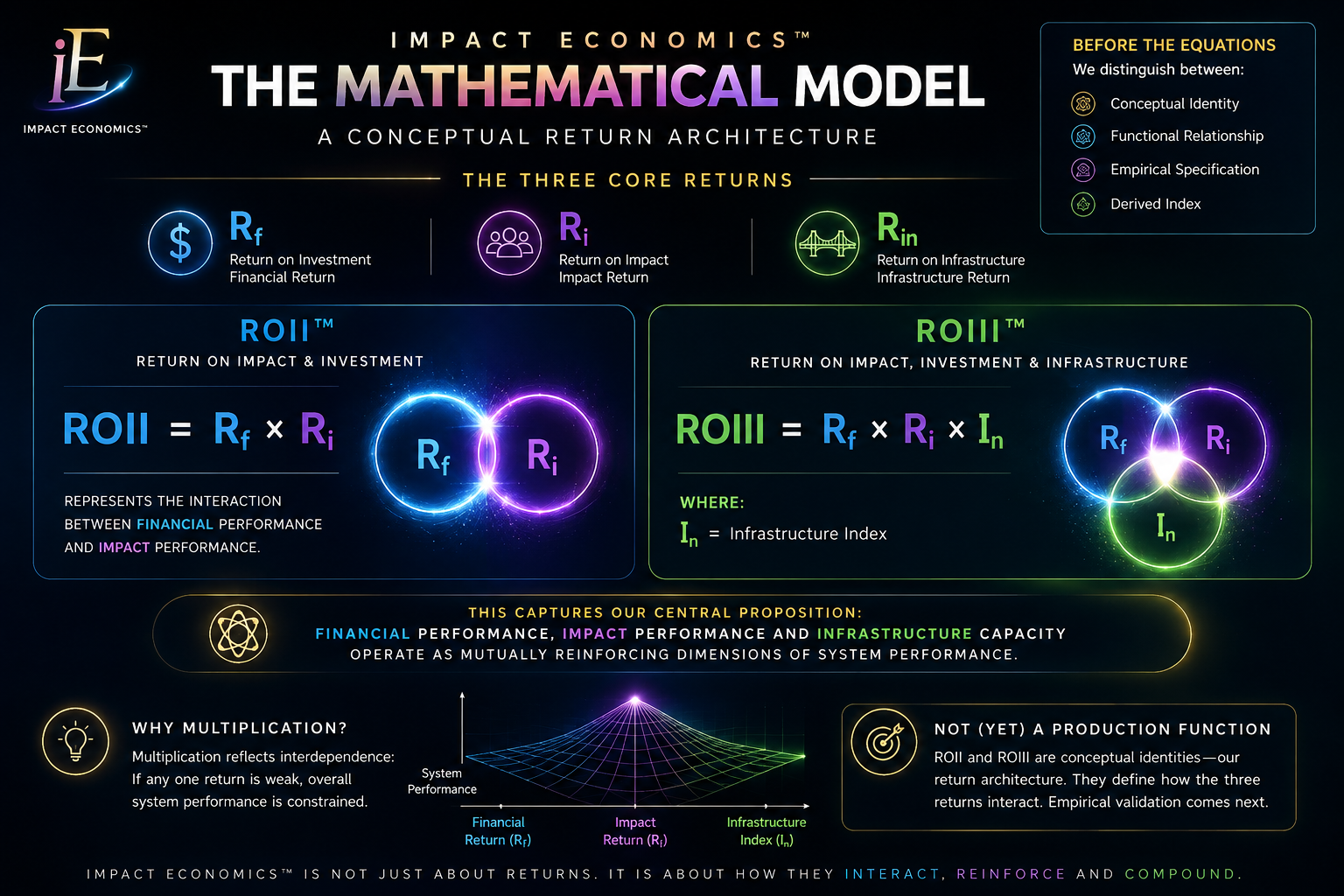
Return on Impact - Ri
Ri represents measurable changes in societal, human, economic-participation and environmental conditions attributable to the activity or system, requiring explicit indicators, baselines, time horizons and attribution methods rather than treating “impact” as an unbounded qualitative concept.
Return On Investment - Rf
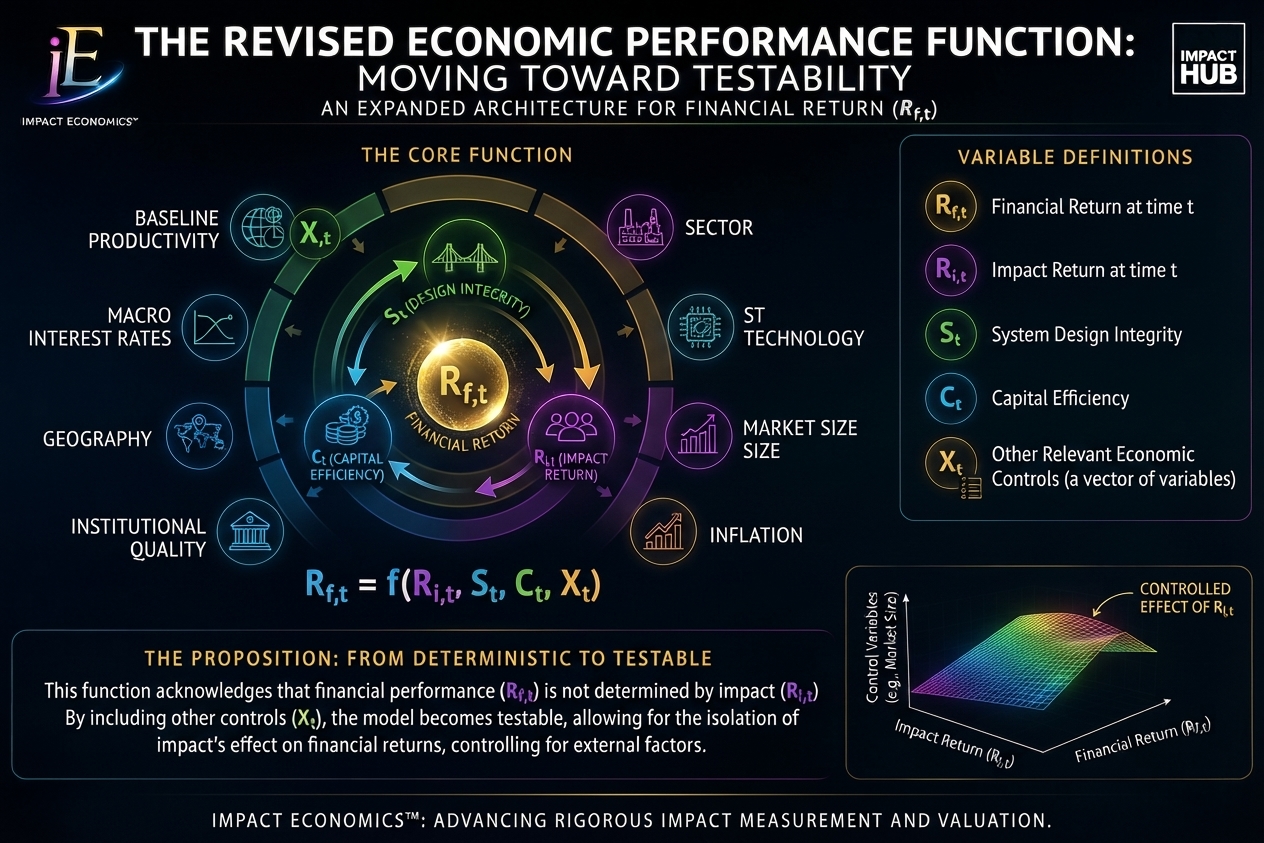
Rf represents the financial return generated by an economic activity, investment or system over a defined period, expressed through measurable outcomes such as revenue generation, profitability, productivity, asset appreciation, capital efficiency or other appropriately specified financial performance measures.
Return On Infrastructure - Rᵢₙ
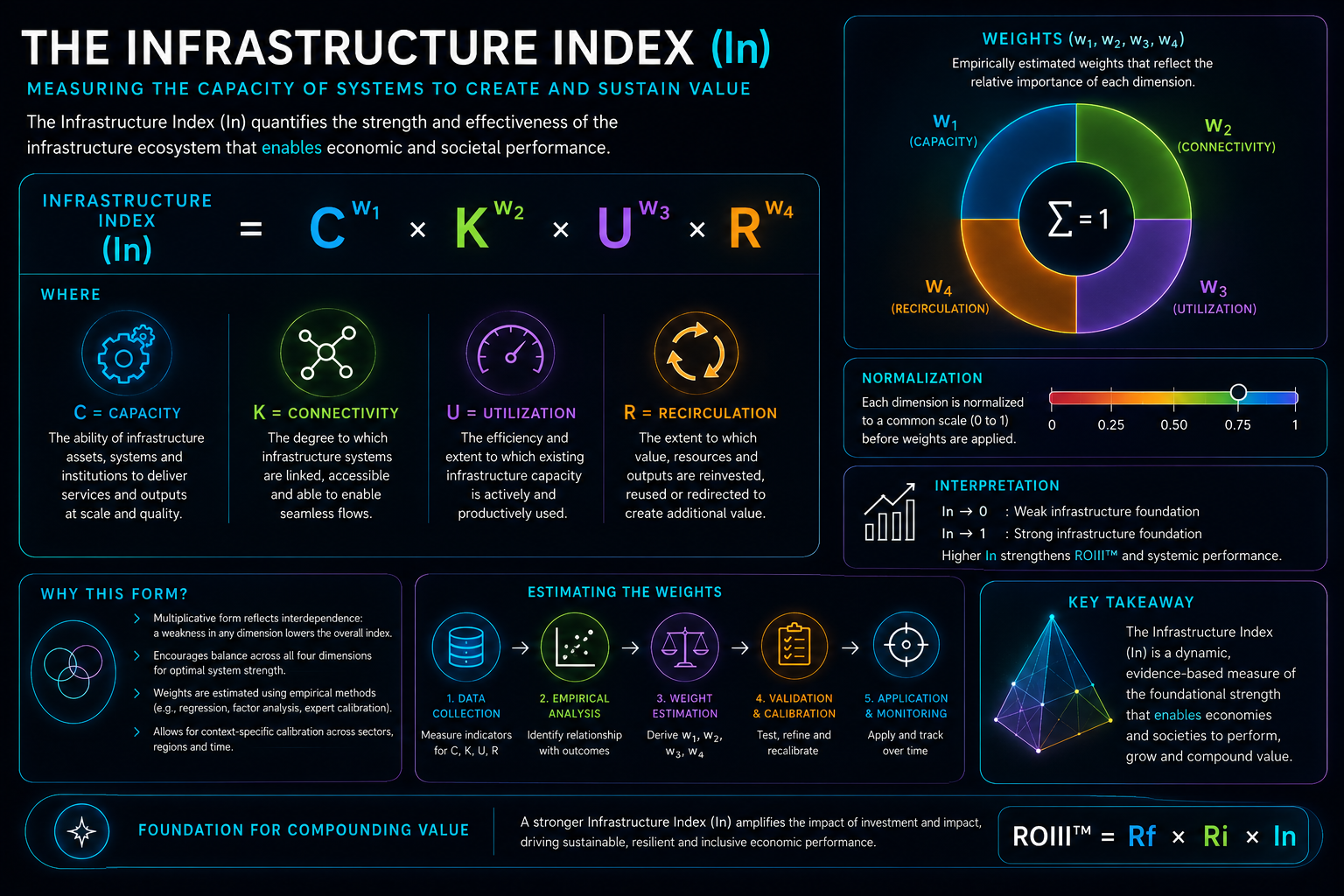
Rᵢₙ represents the change in productive system capacity generated or enabled by infrastructure, including improvements in capacity, connectivity, utilization and value recirculation that alter the efficiency with which capital and other productive resources can generate subsequent economic output.
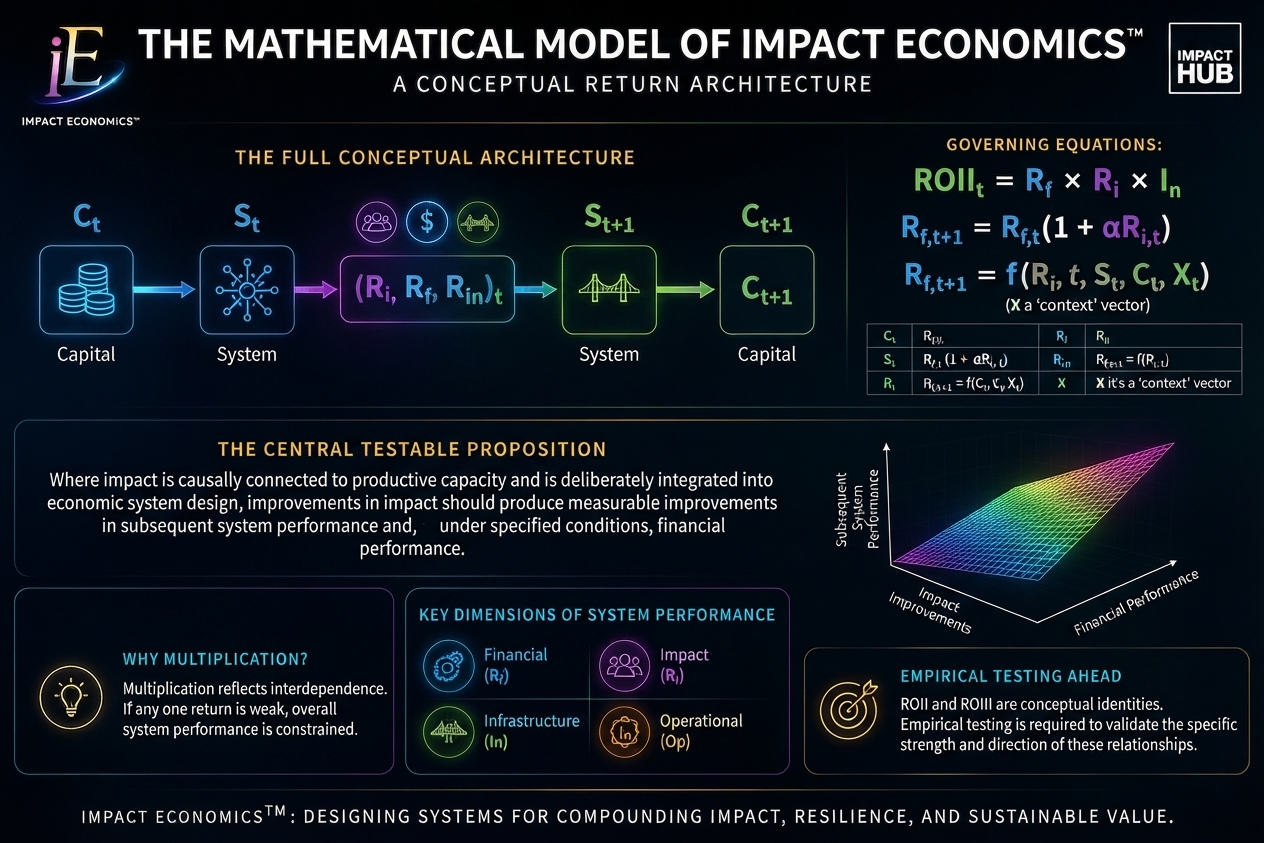
System Design Integrity - S
S represents the degree to which the institutional, capital, operational and sectoral components of an economic system are coherently designed, coordinated and capable of transmitting value between otherwise interconnected economic activities.
Capital Efficiency - C
C represents the efficiency with which deployed capital is converted into measurable economic and systemic outputs, allowing the model to distinguish between the amount of capital deployed and the productive value generated from that capital.
Impact Efficiency Coefficient - α
α represents the empirically estimated strength of the relationship between specified impact improvements and subsequent financial performance within a defined system, sector, population and time period.
Transforming Impact From Outcome Into Economic Infrastructure
Endogenous Growth Theory
Recognizing human capital, knowledge, innovation and technological advancement as endogenous drivers of productivity, economic growth and long-term increases in productive capacity.
Endogenous Growth Theory
Recognizing human capital, knowledge, innovation and technological advancement as endogenous drivers of productivity, economic growth and long-term increases in productive capacity.
Institutional Economics
Recognizing institutional structures, governance arrangements, incentives and organizational quality as determinants of economic behavior, resource allocation, productivity and development outcomes.
Institutional Economics
Recognizing institutional structures, governance arrangements, incentives and organizational quality as determinants of economic behavior, resource allocation, productivity and development outcomes.
Development Economics
Examining structural transformation, human development, productivity, economic participation and institutional capacity as interconnected determinants of development and long-term economic advancement.
Development Economics
Examining structural transformation, human development, productivity, economic participation and institutional capacity as interconnected determinants of development and long-term economic advancement.
Welfare Economics
Recognizing that economic performance extends beyond market output to include welfare effects, externalities, distributional outcomes and broader consequences of economic activity.
Welfare Economics
Recognizing that economic performance extends beyond market output to include welfare effects, externalities, distributional outcomes and broader consequences of economic activity.
Environmental & Ecological Economics
Recognizing environmental resources, natural capital, ecological constraints and resource systems as integral determinants of economic sustainability, resilience and long-term productive capacity.
Environmental & Ecological Economics
Recognizing environmental resources, natural capital, ecological constraints and resource systems as integral determinants of economic sustainability, resilience and long-term productive capacity.
Impact Investing
Connecting financial capital with measurable societal and environmental outcomes while establishing an investment discipline through which capital allocation can pursue both financial and impact objectives.
Impact Investing
Connecting financial capital with measurable societal and environmental outcomes while establishing an investment discipline through which capital allocation can pursue both financial and impact objectives.
Redesigning Economic Systems For Resilience, Participation And Prosperity
Value Integration
Reframing financial value and societal value as structurally interconnected outputs of the same economic activity rather than separate objectives measured through different systems.
Impact Production
Moving impact from an outcome that is measured after economic activity into a productive variable deliberately incorporated into the design and operation of economic systems.
Recursive Economics
Replacing predominantly linear economic flows with a recursive architecture in which economic and societal outcomes feed back into the conditions that generate subsequent value.
Systemic Return
Expanding the concept of return beyond financial performance to examine the interaction between investment return, impact return and infrastructure capacity.
Capital Stratification
Recognizing that different forms of capital perform different systemic functions, requiring capital to be sequenced and matched to distinct stages of economic development and system maturity.
Infrastructure Valuation
Treating infrastructure not merely as a supporting asset or expenditure category but as an active determinant of economic capacity, efficiency, connectivity, utilization and return generation.
Integrated Measurement
Creating a measurement architecture capable of examining financial performance, impact performance and the efficiency with which improvements in one dimension influence performance in another.
Economic Engineering
Moving the unit of intervention from the individual investment or project toward the architecture of the economic system itself, allowing capital, institutions, sectors and societal outcomes to operate as an integrated system.
Engineering Integrated Systems That Generate Compounding Economic And Societal Returns
The Causal Mechanism
Impact Economics™ proposes that societal and infrastructural improvements can affect economic performance through identifiable transmission mechanisms rather than through an assumed relationship between “good outcomes” and “good economics.
Capital Deployment
Capital is allocated not only toward productive assets and enterprises but toward the human, institutional and infrastructural conditions required for those assets to perform.
Sustem Activation
Capital activates enterprises, institutions, infrastructure and services that convert resources into productive economic and societal activity.
Impact Production
Economic activity produces measurable changes in employment, income, capability, access, health, productivity, environmental conditions and participation.
Capacity Enhancement
Those improvements increase the productive capacity of individuals, enterprises, institutions, infrastructure and markets.
Economic Transmission
Greater capacity can influence productivity, participation, transaction costs, market formation, enterprise performance and resource efficiency.
Financial Reinforcement
Where those mechanisms are sufficiently strong, improved system performance translates into stronger revenue generation, capital efficiency, asset performance or economic growth.
System Reinvestment
A portion of the resulting value is reinvested into the conditions that generated the improvement, increasing the system's capacity for subsequent cycles.
Recursive Compounding
Repeated cycles can progressively raise the system's baseline capacity, creating the possibility of increasing rather than merely repeated returns.
How Do We Measure Impact?
Measuring observable societal, economic and environmental changes through defined outcomes, measurable indicators, attributable results and demonstrated system-level effects.
001
Input Measures
Measuring the resources deployed into the system, including financial capital, infrastructure, institutional capacity, technology, human resources and time.
002
Output Ideas
Measuring immediate economic and operational activity generated by the intervention, including enterprises activated, jobs created, services delivered, infrastructure utilized and capital deployed.
003
Impact Measures
Measuring changes experienced by people, enterprises, institutions, communities and environments, including income uplift, employment quality, productivity, access, skills, health, environmental improvement and economic participation.
004
System Measures
Measuring whether the impact is actually altering the performance of the economic system through changes in productivity, capital efficiency, participation, transaction costs, utilization, resilience, connectivity and subsequent financial performance.
Human Capital → Economic Performance
There is substantial evidence connecting health, knowledge and skills with productivity, employment and economic prosperity. The World Bank describes human capital as a foundation of economic growth and poverty reduction and its current HCI+ framework explicitly connects health, education and employment with future earnings and economic growth.
Infrastructure → Economic Capacity
Infrastructure affects the ability of economic actors to connect, transact, produce and participate. Within Impact Economics™, this becomes a testable proposition concerning whether improvements in infrastructure capacity, connectivity and utilization increase economic output or capital efficiency.
Institutional Quality → Economic Performance
Institutional economics provides a substantial theoretical and empirical foundation for examining how institutions, incentives and governance arrangements affect economic behavior and development.
Impact → Investment Performance
Impact investing provides evidence that financial capital can intentionally pursue measurable social and environmental outcomes alongside financial returns. The GIIN defines impact investments precisely around that dual objective and reports a global impact-investing market exceeding $1.5 trillion.
Measurement → Capital Allocation
The impact-investing field has developed increasingly sophisticated measurement and management systems, including IRIS+, which provides standardized metrics and frameworks for assessing impact across investments and enterprises.
Fields
Primary Question
Primary Unit
Impact Economics™ Difference
Development Economics
How do economies develop and transform?
Countries, households, sectors
Integrates development variables into a formal dual-return system architecture
Welfare Economics
How does economic activity affect welfare and allocation?
Individuals/Society
Treats societal outcomes as productive variables within economic system design rather than primarily welfare consequences
Endogenous Growth Theory
How do internal factors generate sustained growth?
Economy / production function
Extends the productive-factor logic toward measurable societal and infrastructural reinforcement mechanisms
Institutional Economics
How do institutions shape economic outcomes?
Institutions / governance
Connects institutional mechanisms to capital deployment, impact production and recursive returns
Impact Investing
How can capital generate financial and measurable impact returns?
Investment / asset / portfolio
Moves the analytical unit from the investment transaction to the architecture of the economic system
Sustainable Development
How can economic, social and environmental objectives coexist over time?
Development system
Provides an economic production and return architecture for examining how those dimensions interact
Impact Economics™
How can an economic system be engineered so financial performance, impact and system capacity reinforce one another?
Economic system
Treats the relationship itself as the object of design, measurement and optimization
Testable Hypotheses
Formulating measurable hypotheses to determine whether integrated impact, infrastructure and financial performance produce stronger economic outcomes over time.
001
H1 — Impact–Financial Performance
Higher measurable impact is positively associated with subsequent financial performance when impact is structurally embedded within economic activity.
002
H2 — Impact–Productivity Relationship
Improvements in human, social and environmental conditions increase productive capacity, resulting in measurable improvements in economic productivity.
003
H3 — Infrastructure–Economic Performance
Greater infrastructure capacity, connectivity, utilization and recirculation are positively associated with financial performance and system efficiency.
004
H4 — Integrated Systems
Economic systems that structurally integrate financial, impact and infrastructure dimensions demonstrate stronger performance than systems operating these dimensions independently.
005
H5 — Reinforcement Effect
Systems generating measurable impact demonstrate stronger subsequent performance when impact improvements increase the productive capacity of the system.
006
H6 — Capital Efficiency
Capital deployed through an integrated economic architecture produces greater value per unit of capital than capital deployed through fragmented or isolated interventions.
007
H7 — Systemic Resilience
Economic systems that strengthen human, institutional, environmental and infrastructural capacity demonstrate lower systemic fragility and greater resilience over time.
008
H8 — Compounding Performance
Systems with stronger financial–impact–infrastructure interdependence demonstrate greater cumulative performance over multiple periods than predominantly linear systems.
009
H9 — Impact Efficiency
The relationship between impact and financial performance varies according to system design integrity, with stronger system integration producing a higher Impact Efficiency Coefficient (α).
010
H10 — Recursive Value Creation
Where financial returns are partially reinvested into the conditions generating impact and productive capacity, subsequent economic cycles demonstrate increasing system capacity and value creation.
Experts at Capturing Your Executive Team

Strategic Systems Intelligence, Architecture, Orchestration and Execution
Combining deep systems intelligence, structural architecture capability and end-to-end transformation orchestration to design, integrate, implement, manage and execute complex organizational and ecosystem systems that enable sustained performance, resilience and measurable long-term value creation across dynamic environments and evolving strategic contexts.
Enterprise Transformation Architecture
Transformation Orchestration Frameworks
Organizational Integration Design
Ecosystem Alignment Mechanisms
Implementation and Execution Systems
Continuous Management and Optimization Systems
From Strategic Design to Full System Activationand Realization
EXECUCOMM enables the transition from strategic intent to fully realized operational systems by architecting, orchestrating, implementing, managing and executing transformation at scale, ensuring initiatives are structurally coherent, institutionally aligned and continuously optimized to deliver sustainable impact, adaptive resilience and long-term value creation.
A global economic systems architect firm redefining how nations, enterprises & institutions design growth, structure economies & deliver transformation to connect, capitialize & impact the world.
A national transformation operator integrating strategy, capital, innovation and execution into unified development systems.
Years of dedicated industry experience and expertise.
Strengthening institutions, accelerating development and improving national outcomes.
Systems Design
Designing integrated institutional frameworks, operating models and participation infrastructures enabling sustainable capability development, collaboration and long-term prosperity.
Partnership LoadingResource Mobilization
Mobilizing strategic capital, partnerships, technology infrastructure and investment mechanisms accelerating innovation, participation and sustainable economic transformation together.
Partnership LoadingStrategic Execution
Designing engagement, onboarding, communications and behavioural adoption systems transforming opportunity into sustained participation and measurable societal outcomes.
Partnership LoadingOutcome Stewardship
Measuring, optimizing and sustaining institutional performance ensuring transformation delivers lasting economic, societal and generational value for everyone.
Partnership LoadingEXECUCOMM operates as the invisible architecture behind institutional transformation, providing the systems, intelligence, partnerships, mechanisms and execution environments that enable organizations to evolve.
Applying systems intelligence to strengthen institutions, ecosystems and national development outcomes at scale.
Delivering measurable value through integrated systems, strategic infrastructure and transformative execution models.
Designing sustainable solutions that unlock opportunity, amplify impact and strengthen collective prosperity.




Strategic Advisory & Institutional Leadership
Providing strategic foresight, institutional guidance and transformational leadership frameworks that enable governments, organizations and ecosystems to navigate complexity, align priorities and achieve future-focused outcomes.
Resource, Investment & Ecosystem Activation
Designing and activating investment ecosystems that connect capital, strategic partnerships, funding mechanisms and development opportunities to accelerate innovation, economic participation and scalable regional growth.
Economic & Institutional Systems Architecture
Designing integrated economic, institutional and enterprise systems that align infrastructure, governance, stakeholders and resources to create sustainable models for long-term transformation and prosperity.
Strategic Positioning & Influence
Developing strategic narratives, institutional identities, stakeholder engagement models and influence mechanisms that strengthen visibility, trust, collaboration and global positioning across diverse ecosystems.
Human Capital & Capability Development
Building human development ecosystems through education, skills development, entrepreneurship pathways and capability-building initiatives that transform individuals into active contributors within future economies.
Infrastructure, Innovation & Activation Systems
Creating the operational frameworks, technology ecosystems, implementation mechanisms and activation models required to convert strategic vision into measurable participation, adoption and sustainable outcomes.
Impact Intelligence & Performance
Establishing intelligence frameworks, measurement systems and analytics capabilities that evaluate performance, demonstrate value creation and continuously optimize economic, institutional and societal impact.
Institutional Architecture
Designing the foundational frameworks, operating models, governance structures and interconnected systems that enable institutions, economies and communities to coordinate resources, align stakeholders and achieve sustainable transformation outcomes.
Resources Ecosystem
Mobilizing strategic capital, investment partnerships, funding mechanisms and collaborative financial structures that unlock opportunities, accelerate innovation and create scalable pathways for long-term economic participation and prosperity.
Participation Infrastructure
Building the engagement ecosystems, onboarding mechanisms, communications frameworks and adoption systems required to transform access into meaningful utilization, sustained participation and measurable value creation.
Strategic Influence
Developing positioning strategies, stakeholder ecosystems, institutional narratives and influence mechanisms that strengthen visibility, build trust and align governments, organizations and communities around shared transformation objectives.
Human Capability Systems
Creating education pathways, workforce development frameworks, entrepreneurship ecosystems and lifelong learning mechanisms that empower individuals to continuously develop skills, pursue opportunities and contribute to future economies.
Innovation Ecosystems
Connecting technology, intelligence, entrepreneurship, research and collaborative partnerships to create innovation environments that enable organizations, industries and societies to adapt, evolve and remain globally competitive.
Impact Intelligence
Establishing measurement frameworks, performance analytics and transformation intelligence systems that track progress, optimize outcomes and ensure investments generate sustainable economic, institutional and societal value.
Creating the Systems that Enable Societies to Continuously Learn, Adapt and Thrive
Business Strategy
Designing enterprise, institutional and national-level business strategies that align long-term vision with operational execution, enabling sustainable growth, competitive advantage and structured value creation across complex and evolving environments.
Branding Strategy
Developing identity, narrative and positioning systems that define how organizations, institutions and nations are perceived, strengthening authority, differentiation and influence across regional and global ecosystems.
Digital Strategy
Architecting digital transformation roadmaps that integrate technology, data and platforms into cohesive systems, enabling modernization, efficiency, scalability and future-ready operational capability.
Innovation Strategy
Creating structured innovation frameworks that enable ideation, experimentation and commercialization, positioning organizations and ecosystems to continuously adapt, evolve and lead within emerging markets and technologies.
Impact Strategy
Designing measurable impact frameworks that align purpose, performance and outcomes, ensuring initiatives deliver tangible economic, social and institutional value at scale and over time.
Change Strategy
Designing structured transformation approaches that enable organizations, institutions and ecosystems to navigate complexity, overcome resistance and transition effectively from current states to future-ready operating models through aligned leadership, adaptive systems and sustained execution discipline.
Partnership Strategy
Structuring strategic alliances across public, private and development sectors that unlock shared value, mobilize resources and accelerate coordinated transformation across ecosystems.
Conservation Strategy
Designing structured sustainability and preservation frameworks that enable organizations, institutions and ecosystems to protect natural, cultural and strategic resources while balancing development, resilience and long-term environmental, social and economic stewardship.
Project Strategy
Defining end-to-end execution frameworks that translate strategic intent into deliverable programs, ensuring alignment, governance, implementation discipline and measurable outcomes across all phases of delivery.
Business Division
Providing enterprise strategy, market intelligence, financial modeling and investment-ready business frameworks that enable organizations to drive sustainable growth, unlock new revenue opportunities, strengthen competitiveness and deliver measurable economic and operational value.
Business Division
Providing enterprise strategy, market intelligence, financial modeling and investment-ready business frameworks that enable organizations to drive sustainable growth, unlock new revenue opportunities, strengthen competitiveness and deliver measurable economic and operational value.
Creative Division
Transformsing organizational identity through strategic brand architecture, visual systems, stakeholder campaigns and experience design that strengthen market positioning, build trust and enhance visibility, credibility, and engagement.
Creative Division
Transformsing organizational identity through strategic brand architecture, visual systems, stakeholder campaigns and experience design that strengthen market positioning, build trust and enhance visibility, credibility, and engagement.
Technologies Division
Designing and implementing scalable digital ecosystems, enterprise platforms, automation solutions and intelligent technologies that modernize operations, enhance efficiency, improve decision-making and support long-term digital resilience.
Technologies Division
Designing and implementing scalable digital ecosystems, enterprise platforms, automation solutions and intelligent technologies that modernize operations, enhance efficiency, improve decision-making and support long-term digital resilience.
Communications Division
Developing strategic messaging and integrated communication frameworks that strengthen stakeholder relationships, manage reputation and ensure clear, consistent engagement across internal, external and public audiences.
Communications Division
Developing strategic messaging and integrated communication frameworks that strengthen stakeholder relationships, manage reputation and ensure clear, consistent engagement across internal, external and public audiences.
Events Division
Conceptualizing and delivering high-impact conferences, summits, forums and engagement experiences that foster collaboration, showcase innovation, strengthen brand authority and attract partnerships, investment, and opportunity.
Events Division
Conceptualizing and delivering high-impact conferences, summits, forums and engagement experiences that foster collaboration, showcase innovation, strengthen brand authority and attract partnerships, investment, and opportunity.
Photography Division
Capturing high-quality visual assets that document milestones, initiatives and organizational impact, supporting brand storytelling, reporting, marketing and stakeholder communications.
Photography Division
Capturing high-quality visual assets that document milestones, initiatives and organizational impact, supporting brand storytelling, reporting, marketing and stakeholder communications.
Media Division
Expanding organizational reach through strategic content development, digital distribution and multi-channel media strategies that build influence, educate audiences and reinforce thought leadership and market presence.
Media Division
Expanding organizational reach through strategic content development, digital distribution and multi-channel media strategies that build influence, educate audiences and reinforce thought leadership and market presence.
Publications Division
Producing research-driven knowledge assets, including white papers, strategic reports, policy briefs and technical guides, that support decision-making, strengthen institutional credibility and position organizations as authorities in their field.
Publications Division
Producing research-driven knowledge assets, including white papers, strategic reports, policy briefs and technical guides, that support decision-making, strengthen institutional credibility and position organizations as authorities in their field.
Safety Division
Designing and implementing integrated safety, security, risk and resilience frameworks that protect people, assets, operations and critical infrastructure while strengthening organizational preparedness, continuity and capacity to operate confidently in complex and evolving environments.
Safety Division
Designing and implementing integrated safety, security, risk and resilience frameworks that protect people, assets, operations and critical infrastructure while strengthening organizational preparedness, continuity and capacity to operate confidently in complex and evolving environments.
Build Division
Translating strategic concepts, investment opportunities and transformation frameworks into tangible infrastructure, facilities, platforms and development projects that create lasting economic, operational and community value.
Build Division
Translating strategic concepts, investment opportunities and transformation frameworks into tangible infrastructure, facilities, platforms and development projects that create lasting economic, operational and community value.
Creating Unified Systems for Cross-Border Digital Integration and Exchange


Defining Executive Presence, Showcasing Leadership,Culture & Credibility through Impactful Imagery.







EXECUCOMM's Process at a Glance
Providing strategic oversight to ensure we meet and surpass objectives
Strategic Immersion & System Discovery
Deep diagnostic engagement to understand structural realities, ecosystem dynamics, institutional capabilities and strategic intent across interconnected environments.
Vision Architecture & Co-Creation
Designing future-state vision frameworks through collaborative engagement that aligns leadership intent, strategic ambition and system-wide transformation objectives.
Systems Design & Strategic Engineering
Translating vision into structured transformation architecture through the design of integrated systems, frameworks, models and execution pathways.
Alignment & Ecosystem Integration
Ensuring coherence across stakeholders, institutions, policies and operating environments to enable coordinated system-wide transformation readiness.
Orchestrated Implementation & Activation
Leading structured execution through coordinated delivery systems, ensuring strategy is translated into operational reality across all levels of engagement.
Performance Intelligence & Optimization
Embedding continuous measurement, feedback loops and systems intelligence to refine execution, improve performance and maximize impact outcomes.
Institutionalization & Legacy Design
Embedding transformation outcomes into enduring systems, structures and capabilities that ensure long-term sustainability and institutional permanence.
Continuous Evolution & Strategic Stewardship
Providing ongoing strategic stewardship, adaptation support and system evolution guidance to ensure sustained relevance in changing environments.
National 100 Day Plan
2026 Budget
BIR Plan & Prime Minister's Speech
Standard & Poor's Report
Revitalization Plan
Office of the Attorney General
Ministry of National Security
Ministry of Agriculture
Ministry of Legal Affairs
Ministry of Finance
Our Team of Specialists
A distinctive and collegial culture deeply committed to delivering innovative solutions that provide clear, tangible results.






Trusted Partners
Honoured to work and collaborate with such amazing and ambitious partners.
















Strategic Frameworks
Institutional Alignment
Transformation Methodology
Initiative Activation
Partnership Architecture
Institutional Architecture
Economic Architecture
Designing integrated economic frameworks that align participation, investment, resources and value creation pathways to support sustainable growth and long-term prosperity.
Organizational Integration
Creating alignment structures that connect leadership, departments, partners and stakeholders around shared objectives, coordinated execution and measurable outcomes.
Strategic Pillars
Deploying a comprehensive transformation framework that addresses the critical dimensions required to strengthen institutional capability, engagement, innovation and future readiness.
Impact Mechanisms
Designing and implementing strategic projects, platforms and programs that convert institutional vision into measurable participation, value creation and societal impact.
Collective Negotiation Frameworks
Creating mechanisms where an institution uses its scale and influence to secure better outcomes.
Collaborative Operating Ecosystem
Establishing a shared operating environment that enables UTC, partners and stakeholders to collaborate, innovate and execute initiatives through aligned capabilities and resources.
Implementing EXECUCOMM's Institutional Integration Framework
Structurally integratedparticipantsin delivery systems
Infrastrusture
Investment
Implementation
Intelligence & Innovation
Influence
Impact
EXECUCOMM's Systemic Integration
Moving organizations beyond product-led growth into system-aligned institutional integration through the i6 Strategic Integration Framework, enabling structural alignment with enterprise and government operating systems and positioning partners as integrated contributors within long-term national and enterprise transformation ecosystems where value creation becomes coordinated, embedded and continuously reinforced across interconnected institutional and economic systems.
This shift redefines engagement from short-term revenue generation toward long-term systemic positioning, where organizations are integrated into infrastructure planning, policy-aligned initiatives and multi-cycle development programmes, strengthening access to capital flows, extending lifecycle value capture, deepening ecosystem integration and enhancing strategic relevance within priority sectors, while operating within structured frameworks shaped by national priorities, regulatory environments and infrastructure mandates that create durable strategic advantage, improved valuation stability, reduced volatility and sustained participation in economic and institutional transformation.
Infrastructure
Designing and enabling the foundational physical, digital and institutional systems that support national and enterprise transformation, ensuring connectivity, productivity and long-term economic capacity across all development ecosystems.
Investment
Structuring, mobilizing and aligning capital flows across public, private and development sources to finance priority transformation initiatives and ensure efficient, scalable and sustainable resource deployment.
Implementation
Translating strategy, capital and design into coordinated execution systems that ensure programmes are delivered effectively across government, enterprise and ecosystem partners with clarity, speed and accountability.
Intelligence & Innovation
Integrating data, insight, technology and foresight to inform decision-making, enhance system performance and continuously evolve national and enterprise transformation models based on evidence and emerging opportunity landscapes.
Influence
Shaping narratives, institutional alignment and stakeholder ecosystems to strengthen positioning, enhance strategic partnerships and ensure alignment between national priorities, global capital and development agendas.
Impact
Measuring and optimizing economic, social and institutional outcomes to ensure transformation delivers tangible, inclusive and sustainable benefits across populations, sectors and generations.
Strategic Systems Intelligence
Economic Intelligence Systems
Generating structured intelligence on economic conditions, sector dynamics and development trends to support high-confidence strategic decisions.
Strategic Foresight Systems
Identifying emerging opportunities, risks and future scenarios that influence institutional and economic resilience.
Opportunity Mapping Systems
Mapping growth pathways, strategic partnerships and participation opportunities across evolving ecosystems.
Decision Intelligence Systems
Transforming data and insight into actionable intelligence that improves prioritization and execution quality.
Institutional Transformation Architecture
Institutional Identity Systems
Defining coherent regional identity structures that align vision, purpose and positioning to strengthen collective cohesion and global strategic relevance.
Development Framework Systems
Creating structured development models that guide long-term planning, policy direction and execution across interconnected territories and sectors.
Sector Alignment Systems
Enabling coordinated performance across sectors and jurisdictions to reduce fragmentation and strengthen system-wide efficiency and regional coherence.
Strategic Narrative Systems
Developing unified narrative structures that align stakeholders, communicate direction and reinforce strategic intent across regional ecosystems.
Economic Systems Design
Sector Ecosystem Design Systems
Designing interconnected sector ecosystems that enable collaboration, productivity and scalable value creation across regional economic systems.
Investment Structuring Systems
Creating structured capital frameworks that align investment flows with development priorities and long-term impact objectives across regions.
Value Chain Development Systems
Strengthening and optimizing value chains to enhance productivity, competitiveness and systemic economic performance.
Industrialization Design Systems
Designing structured pathways for industrial development, diversification and modernization aligned with long-term transformation goals.
Institutional Systems Integration
Governance Alignment Systems
Harmonizing governance structures and operating models to ensure coherence, accountability and strategic alignment across institutions and jurisdictions.
Public Sector Integration Systems
Integrating public sector systems and processes to improve coordination, efficiency and service delivery performance across regions.
Policy Execution Systems
Translating strategic policy into structured implementation systems that ensure delivery discipline and measurable outcomes.
Inter-Institutional Coordination Systems
Enabling structured collaboration across institutions and agencies to reduce fragmentation and improve collective system performance.
Transformation Execution Systems
Program Delivery Systems
Managing large-scale transformation programs through structured governance, execution discipline and outcome-based delivery frameworks.
Project Integration Systems
Aligning multiple initiatives into unified delivery systems that support broader strategic and transformation objectives.
Stakeholder Execution Systems
Coordinating multi-stakeholder environments to ensure alignment, accountability and execution effectiveness across ecosystems.
Capital Deployment Systems
Structuring capital flow and allocation mechanisms to ensure efficient, transparent and impact-driven investment execution.
Continuous Performance & Impact
Systems
Institutional Performance Systems
Monitoring and evaluating performance across key indicators to enable continuous improvement and evidence-based decision-making.
Impact Measurement Systems
Quantifying economic, social and institutional outcomes to ensure accountability, effectiveness and value realization.
System Optimization Frameworks
Continuously refining systems, processes and structures to improve efficiency, adaptability and long-term performance.
Sustainability Intelligence Systems
Embedding long-term sustainability intelligence into decision-making and system design to ensure enduring resilience and impact.
Strengthening national learning systems to develop skills, innovation capacity, and lifelong human development for a competitive, future-ready workforce.
Strengthening national learning systems to develop skills, innovation capacity, and lifelong human development for a competitive, future-ready workforce.
Driving inclusive economic growth through enterprise development, equitable opportunity access, and structured pathways for sustainable wealth creation nationally.
Driving inclusive economic growth through enterprise development, equitable opportunity access, and structured pathways for sustainable wealth creation nationally.
Protecting natural ecosystems through sustainable resource management, climate resilience strategies, and responsible development aligned with long-term ecological balance.
Protecting natural ecosystems through sustainable resource management, climate resilience strategies, and responsible development aligned with long-term ecological balance.
Fluidly in evolving with challenges by seamlessly turning obstacles into opportunities.
Fluidly in evolving with challenges by seamlessly turning obstacles into opportunities.
Education
Enterprise, Economy & Equity
Environment
Women
Navigating complexities with foresight, ensuring optimal paths to success.
Navigating complexities with foresight, ensuring optimal paths to success.
Crafting unique solutions that resonate and elevate brand narratives distinctly.
Crafting unique solutions that resonate and elevate brand narratives distinctly.
Pioneering fresh approaches that disrupt norms that redefine industry benchmarks.
Pioneering fresh approaches that disrupt norms that redefine industry benchmarks.
Fluidly in evolving with challenges by seamlessly turning obstacles into opportunities.
Fluidly in evolving with challenges by seamlessly turning obstacles into opportunities.
Children
Community
Food & Agriculture
Social Development
Navigating complexities with foresight, ensuring optimal paths to success.
Navigating complexities with foresight, ensuring optimal paths to success.
Crafting unique solutions that resonate and elevate brand narratives distinctly.
Crafting unique solutions that resonate and elevate brand narratives distinctly.
Pioneering fresh approaches that disrupt norms that redefine industry benchmarks.
Pioneering fresh approaches that disrupt norms that redefine industry benchmarks.
Fluidly in evolving with challenges by seamlessly turning obstacles into opportunities.
Fluidly in evolving with challenges by seamlessly turning obstacles into opportunities.
Human Rights
Healthcare
Mental Health
Sport, Culture & Arts
Navigating complexities with foresight, ensuring optimal paths to success.
Navigating complexities with foresight, ensuring optimal paths to success.
Crafting unique solutions that resonate and elevate brand narratives distinctly.
Crafting unique solutions that resonate and elevate brand narratives distinctly.
Pioneering fresh approaches that disrupt norms that redefine industry benchmarks.
Pioneering fresh approaches that disrupt norms that redefine industry benchmarks.
Fluidly in evolving with challenges by seamlessly turning obstacles into opportunities.
Fluidly in evolving with challenges by seamlessly turning obstacles into opportunities.
Innovation
Safety & Sustainability
Charity & Philanthropy
Change in Policy
The Dynamism of a Unique Impact Portfolio
Building a brand that supports growth and evolution across industries and landscapes.








The Good Candidates
A human capital and leadership development ecosystem focused on identifying, shaping, and advancing high-potential individuals through structured pathways of mentorship, governance exposure, and strategic opportunity alignment, positioning The Good Candidates as a catalyst for cultivating the next generation of ethical leadership, civic responsibility, and societal transformation.
ENDEAVOUR | ENDEAVOUR Kids
A multi-layered entrepreneurship and youth development platform that enables enterprise creation, innovation thinking, and economic empowerment from early stages through structured training, incubation, and access pathways, positioning ENDEAVOUR as a foundational ecosystem for building sustainable livelihoods, entrepreneurial capacity, and future-ready economic actors across generations.
MONNI™
A comprehensive financial empowerment ecosystem designed to strengthen financial confidence, knowledge and decision-making through accessible education, digital platforms, publications, engagement experiences and community initiatives, positioning MONNI™ as a catalyst for creating financially informed citizens, increasing investment participation and advancing a culture of wealth creation across Trinidad & Tobago.
Happi Monni™
A future-focused financial foundations ecosystem designed to introduce children and young people to money management, saving, investing and entrepreneurship through immersive learning experiences, digital tools and developmental pathways, positioning Happi Monni™ as a catalyst for building financially confident generations and preparing future citizens for meaningful economic participation.
ENTRUST
A national financial advisory and intelligence ecosystem designed to provide individuals, families and businesses with personalized financial assessments, strategic guidance and wealth-building pathways through independent, data-informed solutions, positioning ENTRUST as a trusted platform that strengthens financial decisions, deepens relationships and enables broader participation in Trinidad & Tobago’s financial future.
The Sisterhood
A structured women’s empowerment and advancement ecosystem focused on leadership development, financial independence, wellbeing, and collective progression through curated programmes, support networks, and capacity-building initiatives, positioning The Sisterhood as a transformative platform for unlocking female potential, agency, and intergenerational impact.
Happy Harvest
A community-driven agricultural empowerment and food systems platform designed to strengthen smallholder productivity, local food security, and agri-enterprise development through structured support, market access enablement, and sustainable farming practices, positioning Happy Harvest as a catalyst for resilient food ecosystems and rural economic transformation.
SMIRK
A mobile oral healthcare system delivering preventive, diagnostic, and basic dental care services directly into communities through outreach units, positioning SMIRK as a community-first healthcare intervention that improves oral health outcomes, reduces access barriers, and strengthens overall public health resilience.
On Sight
A mobile healthcare delivery ecosystem providing accessible, community-based vision screening, diagnostics, and corrective eye care services through outreach units deployed directly into underserved populations, positioning On-Sight as a critical enabler of preventative healthcare access, early detection, and improved quality of life through visual health equity.
SPARQ
A strategic innovation and activation ecosystem designed to identify, ignite, and accelerate high-impact ideas, initiatives, and partnerships through structured problem-solving, rapid prototyping, and cross-sector collaboration, positioning SPARQ as a catalytic platform for turning emerging opportunities into scalable solutions that drive measurable social, economic, and institutional transformation across communities and systems.
TEKKY | TEKK World
A future-focused innovation, technology, and digital capability ecosystem designed to advance digital literacy, emerging technology adoption, and innovation capacity through immersive learning environments, strategic exposure, and applied development pathways, positioning TEKKY as a foundational platform for regional digital transformation and future workforce readiness.
PLANORAMA
A dynamic and immersive national experience that brings development to life by translating Trinidad & Tobago’s strategic priorities into engaging, real-world showcases that connect policy, people and progress in a way that is accessible, meaningful and actionable for all.
HEALIIX
Re-Engineering fragmented healthcare models to cultivate regerative human wellbeing potential, HEALIIX is a next-generation health intelligence and infrastructure ecosystem that transforms fragmented healthcare delivery into a unified, preventative and data-driven ecosystem designed to strengthen human capital, enhance productivity and build resilient societies.
RESTORE
A community regeneration and resilience ecosystem focused on restoring people, places, assets and systems through coordinated social, environmental and economic interventions, positioning RESTORE as a platform for rebuilding community capacity, revitalising neglected spaces, strengthening resilience and converting underutilised resources into renewed social and economic value.
Recycle TT
A community regeneration and resilience ecosystem focused on restoring people, places, assets and systems through coordinated social, environmental and economic interventions, positioning RESTORE as a platform for rebuilding community capacity, revitalising neglected spaces, strengthening resilience and converting underutilised resources into renewed social and economic value.
The Business Club
A dynamic business leadership and strategic networking ecosystem that brings entrepreneurs, executives, professionals and business leaders together through meaningful experiences, collaborative relationships, strategic alliances and purposeful opportunities, positioning The Business Club as a platform for collective ambition, business growth, influence and transformative collaboration across industries and markets.
MANPOWER
A dedicated male development and convening ecosystem creating a safe, constructive and purpose-driven environment where men can openly connect, reflect, build relationships, access guidance and strengthen personal, professional and social capacity, positioning MANPOWER as a platform for positive male identity, responsible leadership, mutual support, personal development and stronger participation in family, community and society.
HARMONNI
A technology-enabled automation and systems integration ecosystem designed to connect people, processes, data and intelligent technologies into more efficient, responsive and scalable operating environments, positioning HARMONNI as a catalyst for organisational transformation that reduces friction, strengthens productivity, improves decision-making and enables institutions and businesses to operate with greater intelligence and coherence.
The Plattform
A purpose-driven media, conversation and influence platform designed to bring people, ideas, experiences and perspectives into one visible space through compelling storytelling, dialogue and cultural engagement, positioning The Platform as an avenue for amplifying voices, challenging conventional thinking, connecting audiences and shaping conversations around the people, issues and opportunities influencing Trinidad & Tobago and the wider Caribbean.
Our Co-Operating Philosophy
Our Collaborative Operating Engine Behind Every Transformation Ecosystem We Build
Co-Creation
Bringing stakeholders together to jointly design strategies, systems and solutions that align ambitions, priorities and long-term transformation objectives.
Co-Investment
Aligning financial resources, assets and opportunities to collectively fund, support and accelerate sustainable growth and development initiatives.
Co-Capability
Combining expertise, infrastructure, technology, networks and institutional strengths to enhance collective capacity and maximize transformational potential.
Co-Execution
Coordinating implementation across partners to ensure strategies are effectively translated into measurable outcomes, impact and long-term success.
Co-Acceleration
Synchronizing capital, capabilities and execution mechanisms to increase momentum, amplify results and rapidly scale transformational outcomes.
Strategic Investment Partnership
Co-investing in the creation of a regional participation ecosystem through financial resources, strategic funding mechanisms and investment support required to accelerate adoption, capability development and measurable economic outcomes across Caribbean markets.
Institutional Ecosystem Integration Partnership
ntegrating EXECUCOMM’s Institutional Integration Model, ecosystem frameworks and regional activation architecture into LinkedIn’s market entry approach, creating the localized operating infrastructure required to successfully connect LinkedIn’s global capabilities with Caribbean institutions, communities, organizations and populations.
Regional Economic Architecture Partnership
Recognizing EXECUCOMM as the regional architecture partner responsible for translating LinkedIn’s global capabilities into localized ecosystems that enable governments, institutions, businesses and citizens to fully access, adopt and benefit from LinkedIn’s infrastructure.
Market Activation Partnership
Developing positioning strategies, stakeholder ecosystems, institutional narratives and influence mechanisms that strengthen visibility, build trust and align governments, organizations and communities around shared transformation objectives.
Capability Development Partnership
Leveraging LinkedIn’s learning infrastructure and professional ecosystem alongside EXECUCOMM’s education pathways, workforce frameworks and community activation models to develop the skills, confidence and capabilities required for future economic participation.
Intelligence & Data Partnership
Combining LinkedIn’s Economic Graph, skills intelligence and workforce insights with EXECUCOMM’s institutional understanding to support better decision-making, workforce planning and investment strategies across Caribbean economies.
Future Generations Partnership
Building LinkedIn Future initiatives that introduce young people to professional identity, digital capability, entrepreneurship and global opportunity pathways while creating the next generation of LinkedIn-native professionals.
Strategic Recognition & Partnership Positioning
Positioning EXECUCOMM within LinkedIn’s partnership ecosystem as the institutional integration partner responsible for enabling regional deployment, stakeholder alignment and measurable transformation outcomes across Caribbean markets.
Impact Measurement Partnership
Developing shared measurement frameworks that track adoption, engagement, skills growth, opportunity creation, workforce outcomes and ecosystem performance to demonstrate the measurable impact created through the partnership.
EXECUCOMM designs institutional operating models, governance frameworks, ecosystem architectures, and strategic infrastructures enabling governments, organizations, industries, and communities to achieve transformation.
Institutional Architects
EXECUCOMM connects governments, corporations, technology partners, institutions, investors, entrepreneurs, communities, and organizations into coordinated ecosystems accelerating innovation, participation, capability development, growth.
Ecosystem Orchestrators
EXECUCOMM creates integrated frameworks strengthening workforce capability, institutional effectiveness, leadership capacity, and readiness enabling societies to adapt, innovate, compete, and evolve.
Capability Builders
EXECUCOMM develops participation infrastructure transforming awareness into adoption, utilization, and outcomes through onboarding, communication, education, engagement, behavioural activation, and community systems.
Participation Engineers
EXECUCOMM integrates technology, capital, governance, intelligence, implementation, and stakeholder ecosystems into cohesive operating environments delivering measurable transformation outcomes at significant scale.
Transformation Integretors
EXECUCOMM establishes governance, transparency, communication, and partnership frameworks creating trust between governments, citizens, organizations, investors, and partners for sustainable collective participation.
Trust Builders
Systems Architecture Design Capability
Designing integrated regional transformation systems, governance frameworks and digital ecosystem architectures that enable interoperability, scalability and coordinated development across multiple Caribbean jurisdictions and institutions.
Execution-Driven Transformation Methodology
Applying structured, delivery-focused transformation methodologies that convert strategic intent into operational programs, regional initiatives and measurable implementation outcomes across institutions and sectors.
Multi-Stakeholder Ecosystem Integration Frameworks
Building coordinated frameworks that align governments, regulators, operators, development institutions, private sector actors and academia into unified regional transformation ecosystems.
Capital & Development Finance Enablement
Structuring investment pathways, development finance alignment, public-private partnerships and regional capital frameworks to support scalable and sustainable transformation initiatives.
Institutional Alignment & Coordination Systems
Strengthening governance structures, inter-institutional coordination mechanisms and decision-making systems to ensure coherent execution across regional member states and agencies.
Regional Identity & Strategic Positioning Architecture
Defining and elevating regional institutional identity, narrative positioning and influence architecture to strengthen the Caribbean’s visibility, credibility and authority in the global digital landscape.
Innovation & Future Systems Design
Developing forward-looking frameworks for digital public infrastructure, AI readiness, cybersecurity resilience, digital trade systems and emerging technology integration across the region.
Long-Term Transformation Continuity Systems
Establishing adaptive systems that ensure sustainability, resilience, institutional memory and continuous evolution of regional transformation initiatives over time.
Fortress Of Economic Architecture
Providing a repository of economic frameworks, system architectures, capital mechanisms, measurement models and transformation tools designed to engineer integrated economic performance.
001
Economic Doctrine
The foundational economic principles, theories, propositions and governing logic establishing Impact Economics™ as a distinct framework for understanding and designing economic systems.
002
System Architecture
The integrated architecture connecting capital, institutions, infrastructure, sectors and societal outcomes into a coordinated system of value creation and reinforcement.
003
Capital Architecture
The Capital Stratification Model structures catalytic, productive, expansion, integrative and regenerative capital according to the different functions required to initialize, activate, scale and sustain economic systems.
004
Institutional Integration
The Institutional Integration Model connects infrastructure, investment, implementation, innovation, influence and impact into a coordinated mechanism for converting resources into systemic outcomes.
005
Sectoral Architecture
The 16 Pillar Model provides the sectoral expression through which Impact Economics™ can be applied across human capital, economic production, planetary infrastructure and sociocultural systems.
006
Return Architecture
ROII™ and ROIII™ establish an integrated approach to examining financial return, impact return and infrastructure capacity as interconnected dimensions of economic performance.
007
Measurement Architecture
Integrated measurement mechanisms translate financial performance, societal transformation, infrastructure capacity and system efficiency into observable indicators that enable performance, comparison and continuous optimization.
008
Transformation Mechanisms
A suite of operating mechanisms, feedback loops, investment structures and implementation pathways designed to move systems from fragmented and linear performance toward integrated and compounding economic outcomes.
009
Economic Intelligence
Analytical frameworks identify systemic constraints, economic opportunities, capital requirements, participation gaps and emerging dynamics to inform strategic economic design and decision-making.
010
Ecosystem Engineering
Designing interconnected enterprises, institutions, sectors, infrastructure and value chains that transform isolated interventions into functioning economic ecosystems capable of generating and retaining value.
011
Impact Engineering
Embedding measurable societal and environmental outcomes directly into economic activity so that impact becomes a productive input, measurable output and mechanism of reinforcement.
012
Recursive Systems
Designing reinvestment and renewal mechanisms that strengthen the human, institutional, environmental and infrastructural foundations upon which future economic performance depends.
011
Impact Engineering
Embedding measurable societal and environmental outcomes directly into economic activity so that impact becomes a productive input, measurable output and mechanism of reinforcement.